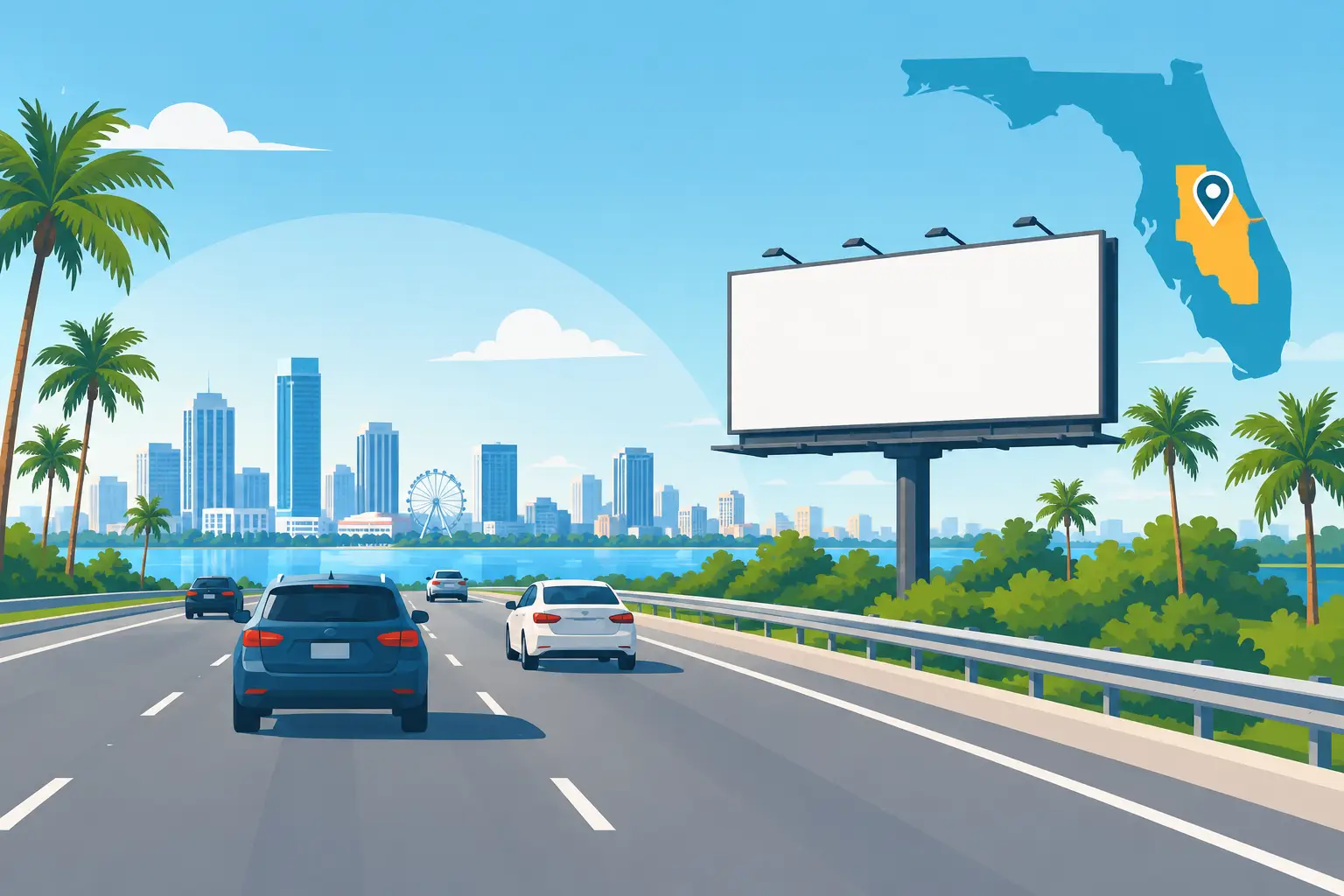

A great billboard can be seen by thousands of drivers every day and still miss the people most likely to buy. The difference is placement. This highway advertising placement guide helps Central Florida businesses choose billboard locations based on real audience movement, market coverage, and the action they want customers to take.
A highway billboard is not simply a large sign beside a busy road. It is a repeated brand message positioned within a daily routine: the commute to Orlando, a family drive toward the attractions, a delivery route through Lakeland, or a weekend trip along I-4. When the location, message, and business goal line up, outdoor advertising becomes a powerful way to stay top of mind.
Start With the Audience, Not the Available Sign
The first question should not be, “Which billboard is open?” Ask who needs to see your message and where they are headed. A restaurant, healthcare provider, home service company, dealership, law firm, retail center, or franchise may all benefit from highway exposure, but their strongest locations can look very different.
A business focused on local lead generation may need a board close to a service area or major exit. A regional brand may prioritize high-volume corridors that deliver broad coverage across multiple communities. A tourism-focused advertiser may want visibility on routes used by visitors arriving from Tampa, Daytona Beach, or the Orlando International Airport area.
Start by defining three practical details: your priority customer, the geography you need to influence, and the decision you want that customer to make. That decision may be visiting a location, remembering a name, searching online later, choosing your brand at the point of purchase, or calling when a need arises.
This approach prevents a common mistake: buying traffic volume without considering traffic quality. A board with exceptional daily impressions is valuable, but only if a meaningful share of that audience can become your customer.
Know What Each Highway Corridor Can Deliver
Central Florida highways carry different audiences at different times. Interstate corridors can provide major reach and frequency, while key state roads and arterial routes may offer more local relevance and proximity to businesses.
I-4: Scale, commuters, and visitor traffic
I-4 is one of the region’s most recognized advertising corridors. It connects major population centers and employment areas while carrying residents, commuters, convention attendees, and tourists through Orlando, Davenport, Lakeland, and beyond. For brands that need widespread awareness, an I-4 campaign can put one message in front of a highly diverse audience again and again.
The trade-off is that I-4 placement demands a disciplined message. Drivers move quickly, traffic conditions vary, and the visual environment can be competitive. Your creative needs to communicate the brand and core benefit in seconds.
Local highways and arterials: relevance near the decision
High-traffic local routes can be especially effective when customers are close to taking action. A board near a retail district, medical center, residential growth area, or business hub can reinforce a nearby destination. These placements often work well for businesses that depend on local service calls, store visits, appointments, or neighborhood recognition.
A lower traffic count does not automatically mean lower value. If the audience is concentrated in the right trade area, a local route can produce a more efficient result than a broader corridor that reaches people outside your service radius.
Growing corridors: get ahead of the market
Davenport, Winter Haven, Ocala, Sebring, and Lakeland continue to present opportunities for businesses following population growth, commuter patterns, and new commercial development. Brands that establish a visible presence before a market becomes crowded can build familiarity while competitors are still relying on scattered digital tactics.
The right choice depends on your growth plan. A market-entry campaign may favor broad coverage and a simple introduction. An established local brand may benefit more from locations that defend market share around its strongest customer zones.
Use Traffic Counts Correctly
Traffic counts are useful because they estimate the volume of potential viewers moving through a location. They are not the entire story. A placement decision should also account for direction of travel, visibility, surrounding land use, and the likely time people have to absorb the message.
For example, the same highway can serve two very different audiences depending on which direction a billboard faces. Morning commuters may travel one way toward employment centers, while afternoon traffic heads toward residential communities. If your offer is built around breakfast, morning appointments, or business services, directional visibility matters. If you want families to consider dinner, shopping, or entertainment, the evening drive may be more important.
Look at the approach to the sign as well. Is the board visible from a distance? Does it appear after a curve, near an interchange, or within a long open stretch of roadway? Is the audience likely to be moving at highway speed or slowed by congestion? High visibility and a clean viewing window help a short message do its job.
Match Placement to the Campaign Goal
Every billboard campaign should have a primary job. When that job is clear, placement choices become easier to evaluate.
For brand awareness, prioritize reach and repeated exposure across the markets you serve. Multiple boards along major commuter routes can help a new brand feel familiar quickly. For a location opening, place boards along the routes customers use to reach the site and consider directional boards that support the drive-time decision. For lead generation, focus on areas with strong concentration of likely customers and use a memorable phone number, URL, or simple call to action.
If you operate across Central Florida, a network of strategically selected locations often outperforms putting the full budget into one highly visible board. One dominant placement can create impact, but several well-chosen placements create frequency. People rarely act the first time they see a message. Repetition builds recall, credibility, and preference.
Build Creative for Highway Speed
A placement cannot compensate for cluttered creative. Highway audiences do not have time to read a paragraph, compare multiple offers, or decode a clever visual. The strongest billboard messages are immediate.
Lead with one idea: a brand name, a clear benefit, a compelling offer, or a category-defining statement. Use large type, high contrast, and a visual that supports the message instead of competing with it. If the billboard includes a call to action, keep it easy to remember. A short URL, recognizable location cue, or straightforward instruction works better than a string of details.
Digital billboards add flexibility for brands that need timely messages, multiple creative versions, or daypart-specific communication. A lunch offer can run when people are approaching midday decisions, while an evening message can promote dining, entertainment, or retail. Static boards, on the other hand, provide continuous visibility with one uninterrupted message. Neither format is automatically better. The best format depends on the campaign, creative, budget, and desired level of flexibility.
Consider Competition and Visual Context
The billboard next to yours matters. So do the signs, exits, buildings, and retail clusters around it. A location in a crowded sign environment may still perform well if your creative is bold and distinctive, but it requires closer attention to visual separation.
Competition can also be a signal of value. When multiple major brands advertise along a corridor, they are often responding to a proven concentration of consumers. The goal is not to avoid every competitive area. It is to ensure your message has a clear position. If every advertiser is shouting about price, a strong service promise or category benefit may stand out more effectively.
Ask whether the location supports the story you want customers to associate with your business. A premium brand may want an influential, high-visibility corridor. A local service brand may get better results by being seen repeatedly near the homes and neighborhoods it serves.
Plan for Frequency, Timing, and Campaign Length
Billboard advertising works because people see it repeatedly. A single exposure may create recognition. Multiple exposures make the message familiar. That is why campaign length matters as much as location.
Short campaigns can support an opening, event, promotion, or seasonal push. Longer campaigns are generally better for building brand memory, especially for services people do not need every week. A roofing company, attorney, financial provider, or healthcare practice benefits from being visible before the customer has an urgent need.
Seasonality should shape your plan. Central Florida visitor patterns, school calendars, storm season, holidays, and local events can all influence when audiences are moving and what they need. The right timing is not always the busiest period. It is the period when your message is most relevant and your business is ready to respond.
Make Placement Part of a Bigger Marketing Plan
Outdoor advertising performs best when it supports the rest of your marketing. A billboard can make search ads more effective because people recognize the name they see online. It can improve response to radio, social media, direct mail, and local sponsorships by giving every channel a familiar visual anchor.
Keep campaign language consistent across those channels. If your billboard promises fast service, the website, sales team, and digital ads should reinforce that same promise. Consistency turns exposure into trust.
Orlando Outdoor helps businesses evaluate locations, develop high-impact creative, manage production, and coordinate installation so the campaign feels easy from first conversation through launch. The objective is not simply to place a sign. It is to put your message where it can earn attention and help move your business forward.
The best highway placement is the one your ideal customer sees often enough to remember, in the places where your business has the most to gain. Start with that standard, and every location becomes easier to judge.