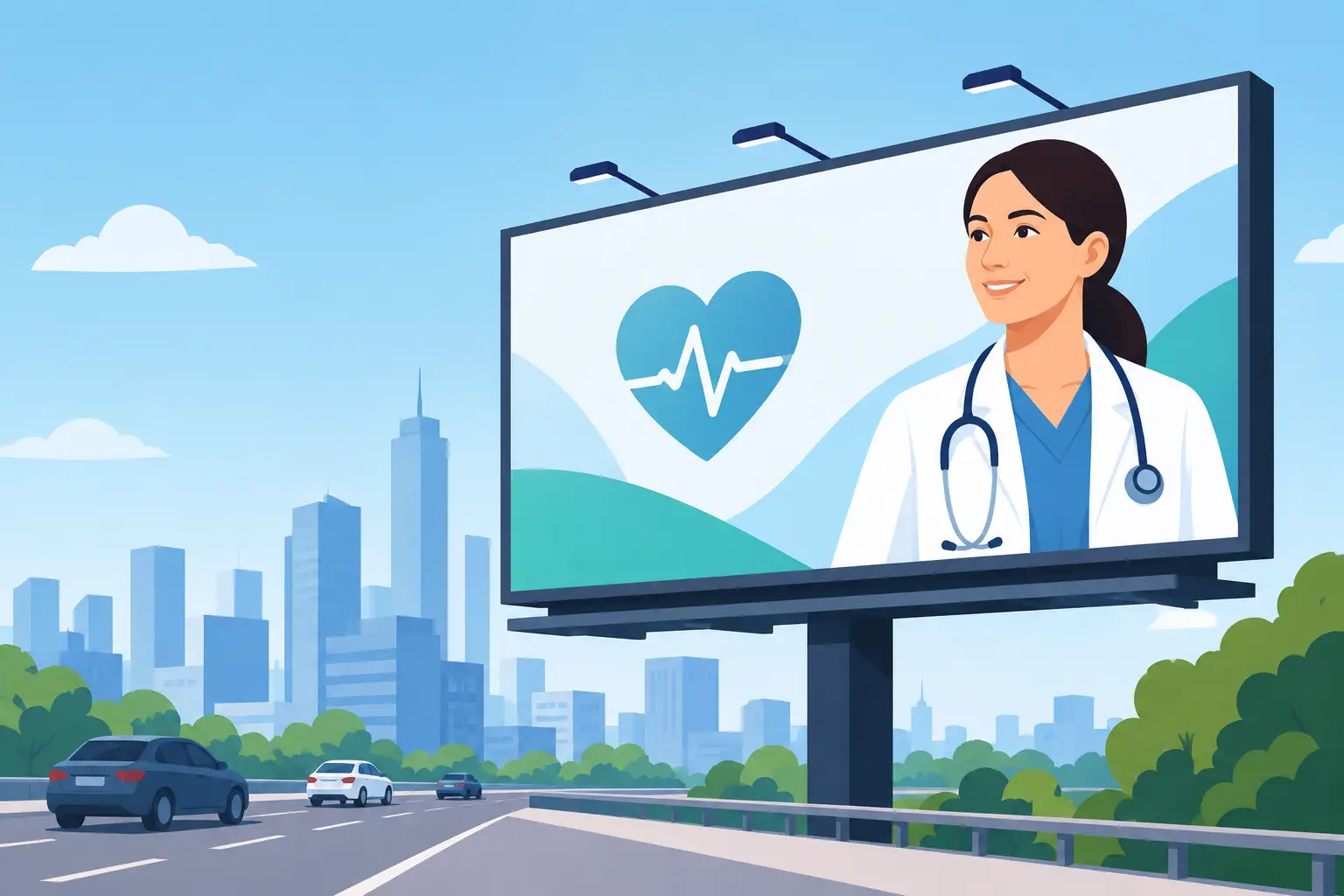

A patient does not usually need to be persuaded that health matters. They need to remember which urgent care is open nearby, which orthopedic group can help with knee pain, or where to schedule that overdue screening. The best healthcare billboard examples answer those questions in seconds, turning daily commuter traffic into recognizable, trusted local awareness.
For healthcare organizations, outdoor advertising works because the need may be immediate, seasonal, or months away. A clear billboard keeps a practice, hospital, specialty center, or health plan top of mind before a patient starts searching. The goal is not to explain every service. It is to make the next choice easier.
What Makes Healthcare Billboards Work
Healthcare marketing carries more responsibility than a retail promotion. Patients are often stressed, short on time, or making decisions for someone they love. That makes clarity, credibility, and location relevance more valuable than clever wording.
Strong healthcare boards typically lead with one service, one patient benefit, and one simple action. A local urgent care may feature extended hours. A surgical practice may focus on a common condition and an experienced specialist. A hospital system may build broad community confidence with a memorable brand message.
The right approach depends on the campaign objective. Brand-building creative can be concise and emotional. Appointment-driven creative needs a sharper offer, recognizable service line, and easy way to respond. In either case, high-contrast design and a message that can be read at driving speed are non-negotiable.
12 Healthcare Billboard Examples for Local Markets
1. Urgent Care for the Everyday Emergency
“Walk In. Feel Better. Open Until 10 PM.”
This message solves a common local problem without overexplaining it. Pair it with the urgent care name, a clear location cue, and a simple web address. It is especially effective near retail corridors, residential growth areas, and commuter routes where families are deciding where to go after work or school.
2. Primary Care That Feels Personal
“A Primary Care Doctor Who Knows Your Name.”
Primary care is relationship-driven, so the message should feel welcoming rather than clinical. This type of campaign works well for independent practices and regional medical groups accepting new patients. Add “Now Accepting New Patients” only if that is the key action you want viewers to take.
3. Orthopedic Relief for Active Adults
“Knee Pain Shouldn’t Bench You.”
An orthopedic billboard earns attention by connecting treatment to the life a patient wants to return to. A golfer, runner, parent, or worker can see themselves in the message immediately. Keep the supporting copy minimal, such as “Sports Medicine and Joint Care,” rather than listing every procedure.
4. Fast Access to Imaging
“MRI Appointments This Week.”
Speed is a powerful differentiator for imaging centers. When a provider can offer timely appointments, say so directly. This healthcare billboard example is strongest near physician offices, hospitals, and heavily traveled routes used by adults managing an injury or ongoing condition.
5. Women’s Health With a Clear Next Step
“Your Annual Exam Is Worth the Time.”
Preventive care messages should be respectful and practical. A women’s health practice can use this concept during awareness months or as an ongoing reminder campaign. Include a short call to action such as “Schedule Today” and avoid piling on too many service descriptions.
6. Pediatric Care for Busy Families
“Same-Day Sick Visits for Little Ones.”
Parents notice messages that reduce friction. This concept communicates urgency, empathy, and a useful service in one line. Bright but professional colors, an approachable image, and a location near family-oriented neighborhoods can make the board even more relevant.
7. Dental Care That Removes Anxiety
“Gentle Dentistry. Brighter Smiles.”
Dental advertising often performs best when it addresses the emotional barrier, not just the service. Patients may delay appointments because of fear, cost concerns, or inconvenience. A reassuring message paired with an offer such as “New Patient Exams Available” can help move interest toward action.
8. Behavioral Health Support Without Stigma
“Support Starts With One Conversation.”
Behavioral health messaging needs care and restraint. Avoid making promises that feel overly broad or using language that could make viewers feel exposed. This example creates a calm entry point, while the practice name and a simple contact path provide a private way to learn more.
9. Senior Care That Reaches Adult Children
“Care for Your Parents. Confidence for Your Family.”
Senior living, home health, and memory care providers often need to reach adult children making care decisions. This message acknowledges both audiences. On a billboard, the emotional benefit is usually more memorable than a long list of amenities or care levels.
10. Specialty Care With a Familiar Symptom
“Heartburn Every Day? Get Answers.”
Specialty providers can generate demand by leading with a recognizable problem rather than a complex medical term. Gastroenterology, sleep medicine, allergy care, and vein treatment all have symptoms that patients understand immediately. The billboard should invite evaluation, not imply a diagnosis.
11. Hospital Brand Awareness Built on Confidence
“Expert Care, Close to Home.”
Hospital systems need campaigns that reinforce scale, quality, and local access. This message is broad enough to support many service lines while remaining relevant to a wide audience. It is a smart choice for high-traffic freeway locations where repeated exposure builds familiarity over time.
12. Health Plans That Simplify Enrollment
“More Care Choices. Help When You Need It.”
For health plans, the message should center on member value instead of policy details. Enrollment periods, benefit changes, and Medicare-focused campaigns can benefit from billboards, but fine print cannot carry the message. Use the board to create recognition and direct people to a simple next step.
Match the Message to the Location
A billboard is most effective when the creative fits the audience moving past it. A pediatric practice may want visibility near family neighborhoods and school travel routes. A medical office in Davenport may prioritize roads serving fast-growing residential communities, while an orthopedic group may benefit from commuter corridors connecting Orlando, Lakeland, Winter Haven, or Ocala.
Distance matters, but relevance matters more. A board near your facility can reinforce convenience for patients already familiar with the area. A board farther out can introduce your brand to communities that lack awareness or are likely to travel for specialized care. The best media plan balances both.
Digital billboards also offer flexibility when a healthcare advertiser has timely messages. Seasonal allergy care, flu shots, open enrollment, new provider announcements, and event promotion can rotate quickly. Static boards, meanwhile, are an excellent fit for sustained brand awareness and service lines that need long-term repetition.
Keep the Creative Easy to Trust
Healthcare billboards should never feel crowded. One headline, a recognizable logo, limited contact information, and strong visual contrast will outperform a board that tries to fit a brochure into a single display. If viewers cannot understand the message in a few seconds, simplify it.
Use patient-centered language instead of internal healthcare terminology. “Back pain relief” is easier to absorb than a detailed treatment name. “Same-day care” carries more value at a glance than a paragraph about operational capabilities. Professional photography can help, but the message should still work if a driver only catches the headline.
Before production, review every claim for accuracy and compliance. Avoid guarantees, unsupported outcomes, or wording that could be read as medical advice. If insurance, eligibility, or promotional terms require extensive explanation, handle those details on the destination page or through staff, not in tiny billboard copy.
A healthcare billboard earns its place in the market by being useful, visible, and memorable. With the right message, design, and Central Florida location, Orlando Outdoor can help turn everyday traffic into lasting patient awareness and stronger local preference.