
A billboard can face thousands of vehicles a day and still miss the people most likely to become customers. That is the costly reality behind many billboard placement selection mistakes. The issue is rarely that outdoor advertising does not work. More often, the campaign is aimed at the wrong traffic pattern, the wrong market area, or the wrong moment in a customer’s daily routine.
Central Florida is not one audience moving in one direction. Orlando tourism corridors, Lakeland commuter routes, Davenport growth areas, Ocala retail traffic, and Winter Haven neighborhood travel all behave differently. A successful placement starts with the people a business needs to reach, then finds the roads they actually use.
1. Choosing a billboard because the traffic count is high
High traffic is attractive, but it is not the same as high-value traffic. A board near a major freeway may produce an impressive number of impressions, yet those impressions may come from travelers passing through rather than local customers who can use a nearby service, visit a store, or recognize the brand later.
A large audience is valuable when broad awareness is the goal. A regional hospital, attraction, auto dealer, statewide law firm, or national consumer brand may benefit from wide freeway coverage. But a restaurant, home service provider, medical practice, or local retailer often needs a more defined audience near its service area.
Before selecting a location, ask a more useful question: Who is in these vehicles, and where are they headed? Traffic count should be one part of the decision, alongside commuter behavior, surrounding businesses, household demographics, tourism activity, and proximity to the places that drive sales.
2. Ignoring the direction of travel
Every billboard has an audience moving in a specific direction. That direction can determine whether the message arrives before, during, or after a customer has the ability to act.
Consider a business trying to increase lunch traffic. A display seen by drivers heading toward the restaurant before noon may be far more effective than one seen on the opposite side of the road during the evening commute. The same principle applies to car dealerships, urgent care centers, apartment communities, entertainment venues, and retail destinations.
Direction also affects readability. Drivers have limited time to absorb a message, especially on high-speed roads. The strongest placement is not simply visible. It gives the right audience enough viewing time to notice the brand, understand the offer, and remember what to do next.
3. Placing the board too far from the buying decision
Distance is not always a problem. A memorable campaign can build awareness well beyond a store or office location. Still, businesses commonly choose a board that is too far from the action when their objective is immediate response.
A destination business may need a location that starts influencing the decision several miles before a turn. A quick-service restaurant, retail store, or service provider with a clear trade area may see greater value closer to the point where drivers can change course. There is no universal distance rule because the right radius depends on the category, the road network, and the customer journey.
The key is to match placement to the campaign’s purpose. If the goal is brand recognition, broader market coverage can make sense. If the goal is visits, calls, or inquiries this week, the sign should be positioned where the audience can realistically act on the message.
4. Treating every Central Florida market the same
Central Florida offers exceptional opportunity, but market conditions change quickly from one community to the next. A placement strategy that works in Orlando may not be the best fit for Sebring, Lakeland, Winter Haven, Davenport, or Ocala.
Orlando routes can deliver a mix of residents, commuters, convention attendees, and visitors. Davenport may offer access to expanding residential communities and vacation traffic. Lakeland can be especially valuable for businesses seeking commuter visibility between major population centers. Ocala has its own blend of local, regional, and seasonal movement.
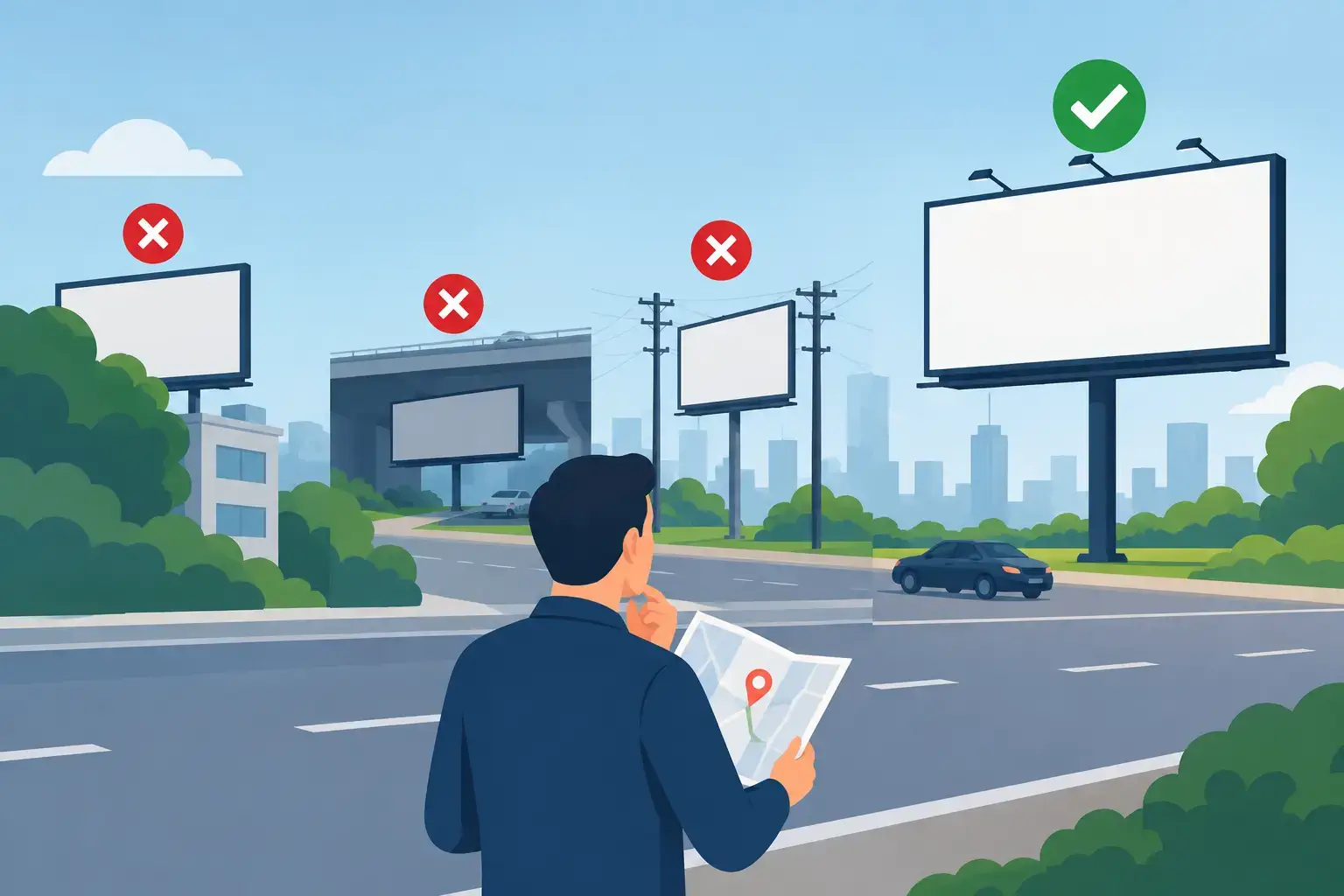
Good placement planning looks beyond a city name. It evaluates the specific corridor, nearby destinations, travel habits, and competitive environment. This is how an outdoor campaign becomes a market strategy instead of a pin dropped on a map.
5. Buying one location when market coverage is the real need
One excellent billboard can make a strong impression. It can also leave major gaps in reach if the target audience travels through several corridors or lives across a broad service area.
Frequency is one of outdoor advertising’s greatest advantages. When people repeatedly see a consistent message on their everyday routes, the brand becomes more familiar and more likely to come to mind when a need arises. That advantage is stronger when placements work together.
A multi-location campaign does not always mean buying the biggest possible schedule. It may mean choosing two or three complementary displays: one that reaches morning commuters, another that captures evening traffic, and another near a high-value retail or tourism area. For brands with a large service area, this approach can create better market coverage than spending the entire budget on one premium location.
6. Overlooking sightlines, speed, and real-world visibility
A location can look ideal on a map but perform differently on the road. Curves, trees, competing signs, construction, lane patterns, and vehicle speed all influence what drivers actually see.
This is why placement selection should account for more than a listed traffic figure. A board on a slower-moving route may offer more time for drivers to absorb a detailed message. A high-speed freeway location may call for a simpler creative approach with fewer words, a bold visual, and a clear brand cue.
The placement and the creative must work as a pair. A message designed for a local arterial road may not be effective on Interstate traffic. Conversely, a clean, high-impact design can be wasted if it is placed where relevant customers rarely travel. Orlando Outdoor helps clients coordinate location planning and creative development so the board is built for the road and audience it will serve.
7. Selecting a location before defining what success means
The final and often most expensive mistake is choosing inventory first, then trying to invent a strategy around it. Without a clear objective, it is difficult to judge whether a placement is truly right.
Start with the outcome. A new business may need broad awareness. An established brand may want to defend its market position. A franchise group may need visibility around several locations. A tourism-focused business may prioritize visitor routes, while a local contractor may focus on residents within a defined service radius.
Then establish practical measures that fit the objective. Reach, estimated impressions, frequency, cost per thousand impressions, store traffic, call volume, website activity, and branded search interest can all help show how the campaign is contributing. Outdoor advertising often works best alongside digital, radio, social, and local promotions, where repeated billboard exposure makes every other message more familiar.
Make placement a business decision, not a guess
The best billboard location is not automatically the busiest sign or the closest sign. It is the one that puts a clear message in front of the right people often enough to influence a real business outcome.
Before committing to a location, map the customers you want, the roads they use, the direction they travel, and the moment when your business is most relevant. With that foundation, billboard advertising becomes more than visibility. It becomes a dependable way to stay top of mind across Central Florida.